

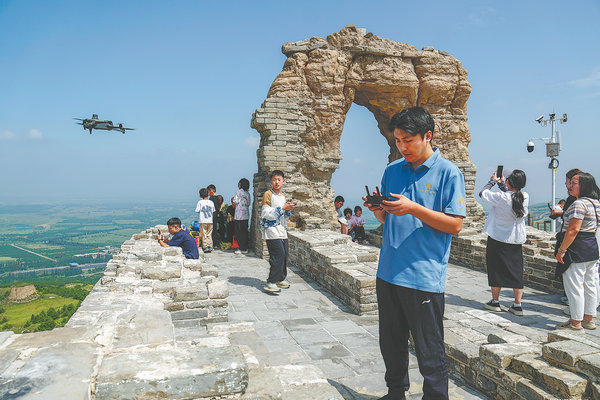
Chai Lihua, from a patrol team in Shanxi province, uses a drone to conduct a safety inspection at the Great Wall section in Shanyin county, Shuozhou, Shanxi. [Photo by Sun Hao/For China Daily]
High above the ancient rammed-earth walls of Heyang Fortress in Shanyin county, Shuozhou, Shanxi province, a drone hovers, its high-resolution camera and infrared sensors scanning the terrain below. On the ground, Zheng Yuan, 35, monitors the live feed on his tablet.
For the guardian from the province's specialized Great Wall patrol team, technology has transformed a race against time into a precision mission.
Shanxi is home to more than 1,400 kilometers of the Great Wall, the third-longest stretch in China. Zheng says comprehensive inspections are often dangerous and challenging tasks for teams on foot.
Equipped with a drone, a laser rangefinder and a 4K camera for the past year, Zheng finds that the advantages brought by tech are undeniable, and can be broken down into three critical areas: efficiency, safety and accuracy.
"Relying solely on foot patrols, like we did just a couple of years ago, made it nearly impossible to complete the annual inspection tasks assigned by the provincial cultural relics authorities on time. The length is immense. But now, with the drones, we can systematically cover this vast territory and consistently meet our deadlines. The drones bring us the efficiency we desperately needed," he says.
With about 70 percent of Shanxi's Great Wall perched in remote and rugged mountains, drones help mitigate risks for his team, especially in harsh weather, like the heavy rain of monsoon season or after snowstorms.
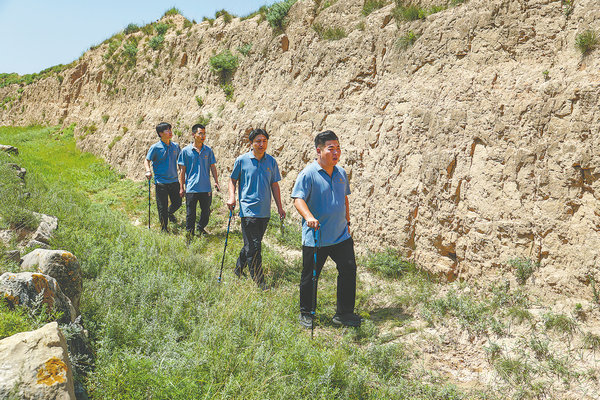
Team members patrol the Great Wall. [Photo by Sun Hao/For China Daily]
Zheng says the accuracy provided by the technology is the biggest help. In a recent patrol of the ancient military fortification in Datong, Shanxi, Zheng's team found a beacon tower where significant digging had occurred nearby.
"When we identify a problem, especially large-scale issues like unauthorized mining or excavation near a site like this, we need irrefutable evidence. We need to know the exact distance from the Great Wall to determine if it's inside the protected zone," Zheng says. He adds that with the help of drones, the area of the damaged land, the volume of earth moved, the exact meters and centimeters to the wall can be calculated.
During his recent patrol at Heyang Fortress where the primary threat is not centuries of erosion, but modern agricultural activity, technology helps him discover two freshly dug irrigation ditches snaking close to the fortress' northern wall, which is a threat invisible to ground observers amid towering crops.
Once a military garrison, later a village, now abandoned farmlands, the fortress area has been under various threats, including seasonal plowing, irrigation and harvesting risk, which erode the fortress base.
"Although the villagers have relocated, the land inside and surrounding the fort is now cultivated," Zheng says, adding that his key task is to inspect for damage caused by farming or any new illegal construction within its protected zones.
Though on flat terrain, 1.5-meter-high cornstalks create blind zones for ground crews. "Before drones, we would miss hazards until walls crumbled," Zheng says.
Today, things are different. Shanxi has pioneered an innovative smart guard plus physical patrol model, a seamless integration of human expertise and cutting-edge technology. Drones provide a bird's-eye view, eliminating blind spots and allowing inspectors to accurately measure threats from a safe distance.
But the tech revolution continues after the discovery. The process is a dual-track system. On-site, Zheng immediately files a hazard report, which is signed by local conservationists and county-level officials. Simultaneously, he uploads high-definition photos, GPS coordinates and detailed data to a provincial online management platform.
"This platform is our digital central nervous system," Zheng says. "The moment we report a hazard, it generates an electronic alert. Experts in the provincial command center can assess its severity in real-time, allowing for a rapid, coordinated response directly from the provincial level. It creates a closed-loop system for problem-solving."
Another good news for Zheng is that Yang Haijun, a retired expert from the Shanxi Cultural Heritage Protection Institute, says that the Shanxi Cultural Relics Safety Command Center will cover all sections of the Great Wall in the province, including beacon towers and other structures, within its scope of cultural relics safety inspection system.
For Great Wall guardians in Shanxi, the future is bright. Zheng envisions a next-generation system integrating satellite remote sensing with drones and foot patrols.
"With satellites, we could monitor the most remote sections monthly or even weekly, catching a destructive activity the moment it begins. That is the future of conservation — not just documenting history, but actively and intelligently preserving it for centuries to come," Zheng says.
 Editor:Qiu Xiaochen

