


Photo shows tourists at a B&B hotel in the Tachuan National Forest Park in Yixian county, Huangshan, east China's Anhui Province. (Photo/Sun Min)
In recent years, Huangshan in east China's Anhui Province has promoted the deep integration of B&B hotels with rural tourism and the cultural industry, enabling B&Bs to inject fresh momentum into rural development.
At 7:30 p.m., accompanied by drum beats, a cultural performance opened at the activity center in Shiting village, Yixian county, Huangshan.
"This group of Shanghai visitors came together because of their shared love of singing. Villagers also have regular performances, so both sides connected immediately," said Huang Zhiyong, owner of a B&B called Shiting Huayi, who initiated the performance.
In recent years, growing demand for cultural and spiritual consumption has driven a transformation in B&B functions. The B&B industry is evolving from meeting basic "accommodation needs" toward fulfilling higher-level "spiritual and aesthetic needs." B&Bs are no longer merely "a place to sleep" but have become multifunctional spaces integrating lodging, aesthetic experiences, social interaction and cultural education.
Yixian county boasts 46 traditional Chinese villages, including the well-known Xidi and Hongcun, and is known as "a secluded paradise, a village straight out of a painting." As one of the birthplaces of Hui culture, it is renowned for well-preserved ancient architectural complexes from the Ming (1368-1644) and Qing (1644-1911) dynasties and distinctive natural and cultural landscapes.
In 2012, after returning from years of entrepreneurship elsewhere, Huang Zhiyong opened a B&B in Yixian county. He chose not to settle in the more famous Xidi or Hongcun. "After visiting several places, I was immediately drawn to this Hui-style courtyard in Shiting village," he recalled. To him, every Hui-style ancient residence is unique and irreplaceable.
"Hui culture is profound—it's not only architectural beauty but also the beauty of opera and craftsmanship. I hope B&Bs can help more visitors appreciate it," he said. He believes that only by integrating the B&B deeply with the village and drawing nourishment from local culture can the business endure.
From 2012 to 2018, he spent six years clarifying property rights for the ancient residence and renovating it.
Traditional Hui-style residences, with their high walls and deep courtyards, often suffer from weak lighting and ventilation. "We preserved the exterior fa?ades—the gray bricks, black tiles and horse-head walls. Without compromising modern comfort, we kept the sky-well courtyard, carved beams and painted rafters," he said.
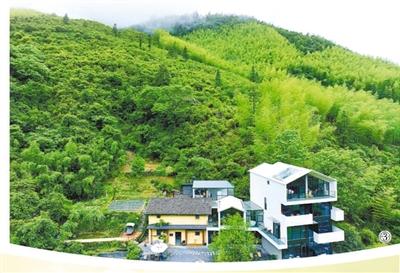
Photo shows Huangshan Yunshang B&B in Huangshan district, Huangshan, east China's Anhui Province. (Photo courtesy of Huangshan Yunshang B&B)
Meanwhile, he drew inspiration from garden layouts typical of the areas south of the Yangtze River, which use architecture and greenery to create bright, elegant public spaces suitable for leisure and entertainment.
While substantial effort went into spatial renovation, enhancing cultural experience was equally important. In addition to a tea room, karaoke room and traditional-style makeup room, Huang regularly invites the Huangshan Hui Opera Theater to perform at his B&B.
He also plans to establish a colored-lantern workshop, where skilled villagers can participate and visitors can experience Hui craftsmanship up close.
Today, Huangshan has more than 3,200 B&Bs of various types, with over 10 B&B clusters emerging. Avoiding homogeneous competition and offering differentiated products and services has become a shared goal among B&B owners in Huangshan.
Cheng Xinfeng, owner of Huangshan Yunshang B&B and an enthusiast of tourism and cuisine, emphasizes product detail and service quality. "Our boutique B&B is committed to providing comfortable spaces and healthy meals," Cheng said.
Located in Tangkou town of Huangshan district, her B&B offers "scenic views from the bed" in a valley surrounded by 10,000 mu (about 666.67 hectares) of bamboo forests. Each room features a private balcony and high-quality bedding and toiletries.
Cheng has cultivated vegetable gardens around the B&B, raising chickens and fish, and purchases tea, honey and dried bamboo shoots from nearby villagers. "These are all products I personally find good and share with customers. Unexpectedly, they really like them too, and after leaving the B&B, they continue ordering agricultural products from me through WeChat," Cheng said.
Sun Min, a post-1985 entrepreneur returning home, targets visitors aged 18 to 40. Tapping into young travelers' desire for social-media-worthy photos, Sun located her B&B in the Tachuan National Forest Park, allowing guests to enjoy views of rice paddies and Chinese tallow trees from their windows.
Sun has designated the first floor as a coffee, dining and reading space, selling Huangshan cultural and creative products and hosting seasonal activities such as "stove-boiled tea" and parent-child study trips.

Armin, owner of Alina's Garden Resort, practices tai chi with his daughter Alina in front of his B&B in Yixian county, Huangshan, east China's Anhui Province. (Photo courtesy of Alina's Garden Resort)
Among Huangshan's B&Bs, Alina's Garden Resort stands out. Its operators are a cross-border couple—Armin from Austria and his wife Huang Qiong from Shenzhen, Guangdong Province.
"Thanks to visa-free entry policies in the past two years, foreign tourists have increased—this is our opportunity. We feel it is important to promote cross-cultural exchange and help foreign visitors understand Huangshan," Huang Qiong said. Foreign guests show strong interest in Chinese culture and prefer to participate rather than just observe. Her B&B currently offers Huangshan hiking and tai chi activities.
On May 1, 2024, Huangshan enacted regulations on B&B promotion and management, explicitly supporting the legal use of idle rural construction land through multiple models.
"Many B&Bs in Huangshan are in rural areas and have become a key to advancing comprehensive rural revitalization. Operators now include both locals and outsiders, and together they have propelled the sector's growth," said Wang Weizhi, head of the rural tourism section at the Huangshan municipal culture and tourism bureau. To help non-local operators settle and run businesses with confidence, Huangshan has carried out many useful explorations, including issuing the regulations.
Wang noted that Huangshan supports Huangshan University and Huangshan Vocational Technical College in establishing B&B-related programs to cultivate management and operation talent. Meanwhile, training courses for B&B managers have been held at both municipal and county levels, with 335 trainees having obtained vocational skill certificates issued by human resources and social security authorities.
 Editor:Cai Xiaohui

